

BOVOBot settings guide
Settings with a clear purpose.
Configure BOVOBot in a controlled sequence: account and route first, followed by capital, markets, signals, protection, and evaluation.
Early Access 0.1.0.31
These defaults are examples, not recommendations.
The download contains Standard Futures plus an account-locked Lead Trade route. Standard Futures remains independent. Lead Trade unlocks only when the configured Main Account matches the embedded authorization. Existing databases and saved settings are not replaced.
- BTC whitelist
- Only BTC is enabled on first installation. This enables a market; it is not an automatic entry signal. Additional symbols are considered only after you deliberately add them. Market selection
- Initial Order: 20 USDT
- 20 USDT is the base amount for the first entry. At 20x leverage, this can produce nominal exposure of up to approximately 400 USDT before fees, slippage, and exchange limits. Base amount
- Leverage: 20x
- Leverage magnifies both gains and losses. 20x does not mean 20 times more safety or profit; it means substantially less distance from critical loss and liquidation levels. High risk
- DCA multiplier: x1
- A multiplier of x1 leaves the calculated DCA base size unchanged. It does not define the number or price spacing of DCA steps and does not guarantee execution. Size factor
- Safe Order multiplier: x1
- The Safe Order also uses the base factor. The open position, available margin, contract rules, and exchange maximum must still permit the actual order. Size factor
- Trailing Start: 0.50%
- From a positive distance of 0.50%, the trailing logic can begin monitoring the achieved move. Fees, rounding, and the actual execution price affect the real result. Activation
- Retracement: 0.10%
- If the relevant move retraces by the configured amount after activation, an exit may be triggered. A fast market can result in a different execution price. Retracement
- Boost: active from 0.52%
- The default increases target leverage by 5x, from 20x to no more than 25x. The actual limit remains constrained by the exchange. Boost increases risk and must be reviewed explicitly before the first start. Additional risk
Review in this order before the first start
- API: allow Futures trading and read access only; keep withdrawal permissions disabled.
- Market: confirm that only BTC is on the whitelist.
- Capital: review the 20 USDT base amount and potential total capital commitment, including DCA and Safe Orders.
- Risk: reduce or disable 20x leverage and Boost from 0.52% before starting if necessary.
- Exit: review Trailing Start at 0.50% together with Retracement at 0.10%.
- Monitoring: keep the bot and KuCoin account open side by side during the first run.
Standard Futures window
Every visible setting, explained in context.
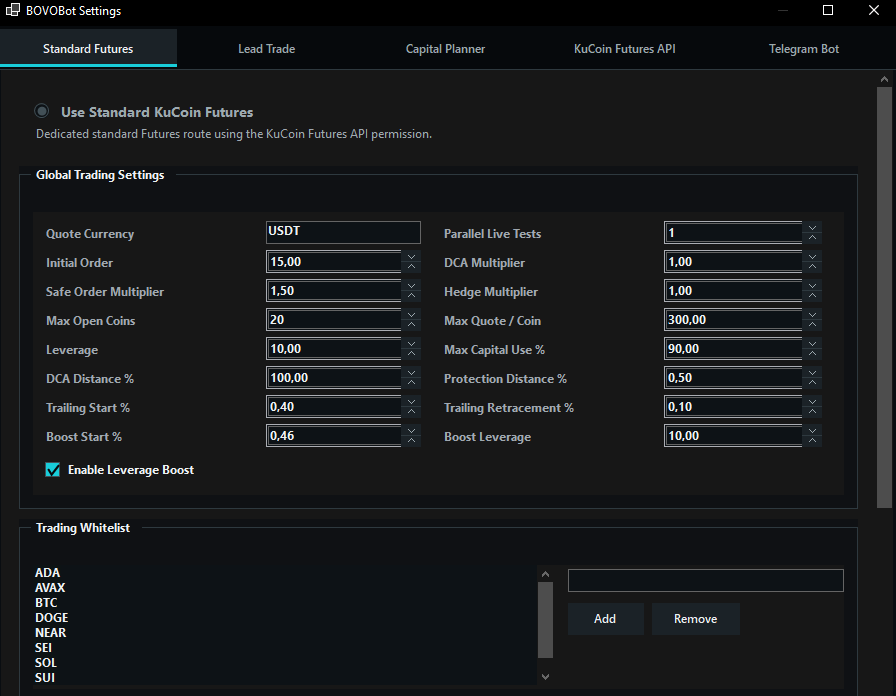
The image on the left shows the real settings window. On the right, every field is grouped by purpose. Values interact with one another; saving alone does not send an order.
Route and market
What is allowed to operate?
- Use Standard KuCoin Futures
- Activates the independent Standard Futures route. The Early Access build also contains Lead Trade, but Lead stays locked until the bound Main Account authorization matches. Route enablement
- Quote Currency
- Sets the settlement and symbol currency, here USDT. This value does not automatically determine the account type, availability, or currency conversion. Market basis
- Trading Whitelist
- Only listed symbols are allowed for monitoring and trading. A small, well-understood selection is easier to control than a full scan. Market enablement
- Add / Remove
- “Add” adds a ticker; “Remove” removes the selected market from the enabled list. Changes become permanent only after “Save Settings”; existing open positions remain unaffected. List management
Capital and size
How large can the exposure become?
- Initial LONG / Initial SHORT
- Separate quote-margin inputs for each direction. A SHORT hedge always starts from Initial SHORT; a LONG hedge starts from Initial LONG. Directional margin
- Long Leverage / Short Leverage
- Independent requested leverage for each side. Leverage changes exposure, while margin caps and the exchange maximum still apply. Side risk
- Maximum Open Coins
- Limits the number of symbols active at the same time. This value must align with the Initial Order, reserves, and potential additional capital commitment. Concurrency limit
- Maximum Quote per Coin
- Upper limit for total quote allocation per coin. It includes not only the first entry but the planned total path for that symbol. Coin limit
- Maximum Capital Usage %
- Limits the total share of route capital that may be committed. A reserve remains important for fees, market movement, and protection actions. Route limit
DCA, Safe Order, and hedge
How are additional actions scaled?
- Parallel Live Tests
- Sets the number of parallel analysis test runs. These tests send no orders, but they can increase CPU, database, and data-fetch load. Analysis load
- DCA Multiplier
- Scales the calculated DCA quantity. x1 leaves the base unchanged; the factor does not automatically limit the number of steps or the total position. DCA factor
- Safe Order Multiplier
- Scales the calculated Safe Order or protection quantity independently of the DCA factor. Available margin, position size, and exchange rules must still permit the order. Safe Order factor
- Fixed hedge margin
- The hedge multiplier is fixed internally at x1. Hedge margin comes only from the configured initial value of the side being opened and is not increased by unrealized PnL. Deterministic sizing
- DCA Distance %
- Controls the distance between additional entries. Tighter spacing can consume reserves faster; wider spacing leaves the position longer without another step. Price distance
- Protection Distance %
- Defines the configured distance for position protection logic. It is not a guaranteed stop or execution price and requires sufficient capital and valid exchange limits. Protection distance
Trailing and Boost
When does trailing or Boost apply?
- Trailing Start %
- Profit threshold at which trailing monitoring can be activated. No trailing retracement is evaluated before that point. Activation
- Trailing Retracement %
- Permitted retracement after activation before a close is considered. Too tight can react to market noise; too wide can give back more unrealized profit. Retracement
- Boost Start %
- Profit threshold from which Boost logic can become eligible. This value has no effect while Boost is disabled. Boost threshold
- Enable Leverage Boost
- Turns the additional leverage stage on or off. For a simple first run, disabling Boost can make the capital path easier to understand. Additional enablement
- Boost Leverage
- Target leverage for the Boost stage, not a guaranteed exchange value. Higher target leverage increases liquidation sensitivity and potential capital requirements. High risk
Save behavior: “Save Settings” stores the reviewed values but does not by itself send a market order. “Cancel” discards unsaved changes.
Learn more about risk and protectionNew hedge system
Profit-Locked Hedge Release, step by step.
The optional system manages a LONG-primary position and its paired SHORT hedge. It closes nothing merely because a price level was touched.
Sizing
Each side uses its own initial margin.
Initial LONG and Initial SHORT are independent. A hedge uses exactly the configured initial margin of the direction it opens, converted with that side leverage and capped by KuCoin.
Arming
A valid LONG trailing stop and profitable basket projection are required.
The projected LONG result and SHORT result are combined. Execution Cost Buffer is deducted, and the remainder must reach Minimum Basket Profit.
Confirmation
The actual LONG fill must be confirmed first.
Only a matched trailing-stop fill with positive realized LONG PnL can permit a reduce-only SHORT close. Missing fill data, an insufficient basket floor or an API failure leaves the SHORT open.
Liquidation guard
An automatic exchange-side guard protects the remaining SHORT.
The bot maintains a buy-stop before the SHORT liquidation price using an internal distance. If no safe trigger can be placed, a critical warning is logged and must be checked directly at KuCoin.
This logic can reduce paired risk only when exchange state and all profit checks allow it. It cannot guarantee fills, profit or protection from liquidation.
Settings sections
From connection to evaluation.
The sections follow a sensible setup sequence for a new system. Changes to capital and execution should always be deliberate and made one at a time.
01 · Account and route
First determine which connection is allowed to trade.
Standard Futures and Lead Trade connect independently. An error in one route must not obscure the other route.
- Standard API
- Connects regular KuCoin Futures access. Key, Secret, and Passphrase must belong to the same API credential set; withdrawal permissions remain disabled. For Standard Futures
- Lead Trade API
- Uses separate Lead credentials. They are not the same as the Standard credentials. For Lead Trade only
- Main Account UID
- The Main UID determines Lead authorization. It is not the same as the UID of the Lead API key. Authorization check
- Route status
- Shows whether each API is validated and its route is ready. Check Standard and Lead separately. Before every start
02 · Capital and limits
Limit exposure before enabling signals.
Capital planning and position limits determine how much operating scope the bot receives.
- Capital allocation
- Defines the portion of available Futures capital allocated to the bot. A reserve prevents every available unit from being committed. Overall limit
- Base order size
- Defines the first position size. It should remain within the selected capital limit even with multiple simultaneous positions. Per entry
- Leverage
- Increases market exposure and risk. Higher leverage reduces the distance to critical loss levels. Risk driver
- Maximum positions
- Limits how many markets may commit capital at the same time. This value must fit the order size and reserve. Portfolio limit
- Additional-order budget
- Reserves capital for planned recovery or Safe Order steps. Without a reserve, a planned protection action may not be executable. Only when the strategy is active
- Capital Planner
- Checks whether order size, position limits, and reserve are mathematically consistent. It does not replace personal risk assessment. Consistency check
03 · Markets and signals
Define what is monitored and when a setup qualifies.
Market enablement limits the search space. Signals then determine which enabled markets qualify.
- Market whitelist
- Contains only the symbols BOVOBot may monitor and trade. A small selection is easier to control. Market enablement
- Timeframe
- Sets the candle resolution for charts and indicators. Shorter timeframes react faster and may contain more market noise. Analysis interval
- SignalScore
- Combines multiple market conditions into one score. A higher threshold requires stronger agreement. Entry filter
- Long and Short
- Controls which trading directions are allowed. Enable both directions only when they fit your setup. Direction enablement
- Auto-entry
- Allows automatic entries once score, route, and risk limits are satisfied. Observe the market display for stability before enabling it. Automation
- Coin-specific values
- Allow different rules for individual markets when volatility or contract structure requires separate treatment. Fine-tuning
04 · Protection and execution
Execution and protection must match the open position.
These settings affect real orders. Also verify their purpose and actual status directly in the KuCoin account.
- Safe Order
- Plans an additional order according to the selected strategy. Quantity and distance must fit the reserved capital. Recovery context
- Protection order
- Associates planned stop or exit orders with a position. Visible status helps identify missing orders early. Position protection
- Open Orders
- Shows unexecuted orders for each route and symbol. Zero open orders matters only when an open position is supposed to have protection. Exchange status
- Force Buy
- A deliberate manual order function. It does not bypass route, authorization, or broker checks. Manual command
- Loss protection on close
- Can restrict closes under configured conditions. It does not prevent liquidation by the exchange. Exit rule
- Broker attribution
- Lead market, limit, stop, and Force Buy orders require active partner attribution. No Lead order is allowed without it. Mandatory Lead validation
05 · Testing and evaluation
Evaluate changes before increasing exposure.
Tests and learning metrics provide context. They are not forecasts or promises of profit.
- Live test
- Observes current market data using the selected rules without automatically deriving greater exposure. Current market
- Backtest
- Applies rules to historical data. Results depend on data quality, time period, and model assumptions. Historical context
- Indicator matrix
- Shows which component conditions contribute to a signal, making the score easier to interpret. Signal transparency
- Learning metrics
- Summarize past observations and results. They should be current and never used in isolation as a reason to trade. Additional information
- Reward evaluation
- Provides context for past decisions and helps compare changes over time. Development over time
- Change routine
- Change one area at a time whenever possible and observe the effect before adjusting additional parameters. Clear comparability
Recommended sequence
How to build a controlled initial configuration.
- 01Connect the route
Validate Standard or Lead separately and check each route's status.
- 02Limit capital
Align order size, leverage, position limits, and reserve.
- 03Narrow the markets
Begin with a manageable whitelist and clear directions.
- 04Observe signals
Review SignalScore and indicators before enabling maximum automation.
- 05Monitor the first run
Actively compare positions, orders, and the exchange account during startup.
Before starting
The short checklist.
Continue to setup
Prepare the first start now.
The getting-started guide covers the API connection through the first controlled observation.